Hurricane Season Tree Prep in Baton Rouge: A Homeowner's Checklist
Trees meet hurricane season exactly as they are - every defect they grew all year is the defect the storm grades.
Read the Guide
Homeowners oscillate between ignoring tree symptoms for years and panicking over harmless ones in a weekend.
Problem: Homeowners oscillate between ignoring tree symptoms for years and panicking over harmless ones in a weekend.
Solution: Symptoms sort into three honest tiers - monitor it, book it, and clear the area now - by what they predict and how fast they move.
When to call: When in doubt with a big tree over a house, the cost of a reading is trivial against the cost of reading the signs wrong.
Every arborist knows the two phone calls: the one that comes five years after the first conk appeared, and the one that comes in a panic over a healthy tree's normal bark shedding. Between those calls lies the judgment this guide teaches - a symptom-by-symptom sorting of what Baton Rouge trees show their owners, into what to watch, what to book, and what to treat as today's emergency. It will not make you an arborist. It will make you the kind of owner whose trees get help at the cheap stage.
The ground finishes the argument. The old city sits on loess bluffs above the Mississippi - the first high ground upriver from the Gulf - while the suburbs east and south spread across flat, heavy alluvial soils that saturate in the long rains. A saturated root plate in heavy soil lets go in wind that a dry-rooted tree would shrug off, which is why the same hurricane drops trees on one street and spares the next: soil and drainage are part of every tree's real condition here.
Some findings are information, not alarms. A modest amount of deadwood in a mature oak's interior. Minor leaf scorch at the end of a brutal August. A slight, long-standing lean that photographs identically year after year. Bark shedding in plates on trees whose species does exactly that. The correct response is documentation: a dated photo, a note in the house file, and a re-check next season against the baseline.
Monitoring is an action, not neglect - provided it has a trigger attached. The rule for every monitored item: name the change that promotes it. Deadwood increasing noticeably year over year, scorch arriving earlier each summer, the lean photo finally differing - any of these moves the tree to tier two, and the file you kept makes that visit twice as useful.
This is the tier where money is saved. Tip dieback progressing into the crown. Leaves shrinking or paling across seasons. A crack, seam or cavity you can find with your hand. A girdling root at the flare, a mushroom at the base, a union weeping or sprouting furiously. A tree that has changed growth - suddenly lush after trenching nearby is as meaningful as decline. Each of these says: the process is underway, the diagnosis is knowable, and the treatment window is open.
Add the situational bookings to the same tier: before construction anywhere near a valued tree, before buying a house with mature canopy, before the hurricane season that follows any storm damage, and whenever a tree you cannot afford to lose has simply never been read. Tier-two visits are the entire economics of tree care - the difference between a treatment plan and a removal quote is usually one tier of timing.
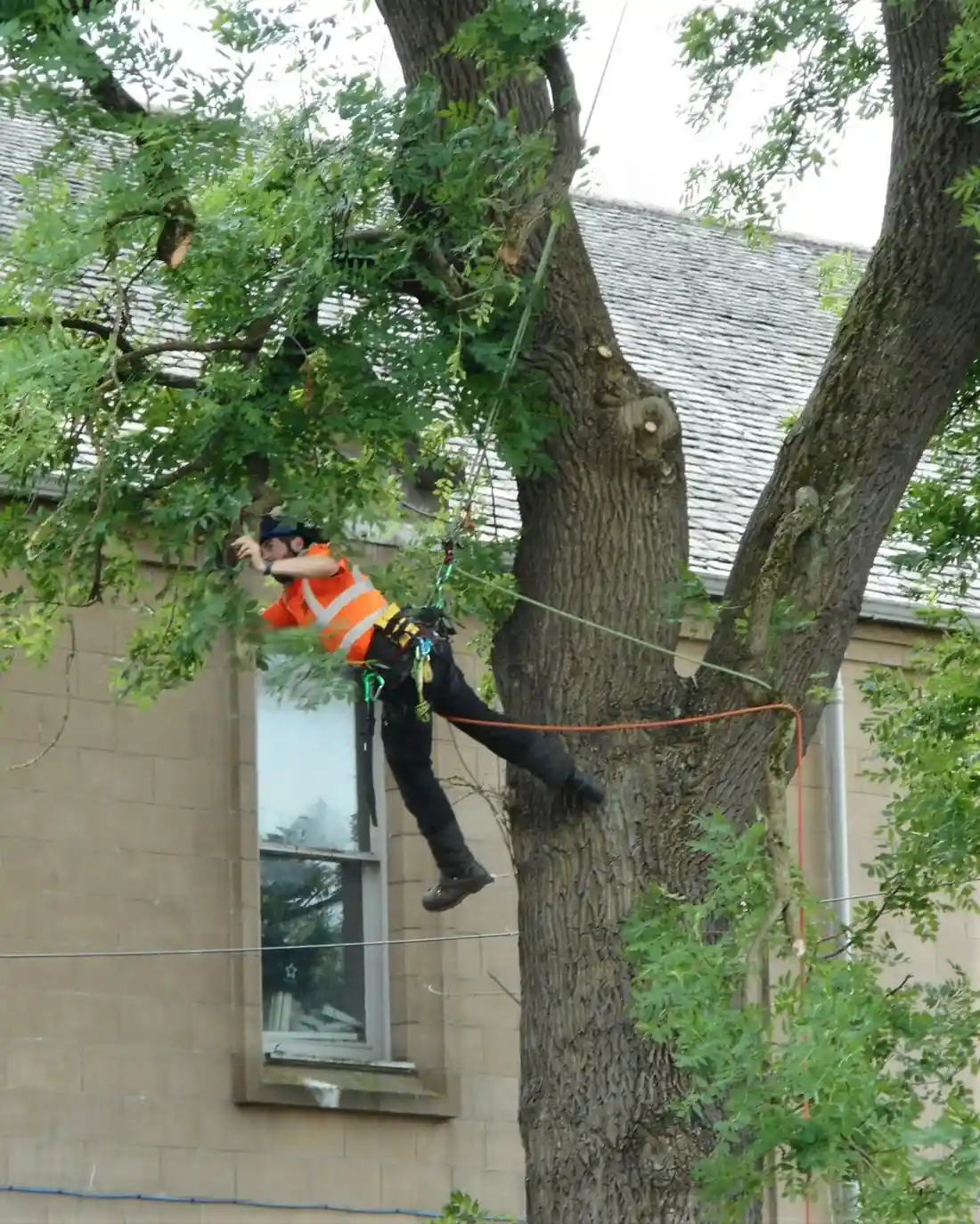

Some signs end the deliberation. A fresh lean with lifted, cracking soil. A trunk crack you can watch open in wind. A split union audibly working. A large hanger directly over the drive or door. A tree resting on the roof, the lines, or another tree. For all of these, the protocol is identical and immediate: people and vehicles out of the fall zone, no heroics with ladders or ropes, and the call placed as an emergency - because the tree has stopped asking for an appointment and started issuing a deadline.
Tier three includes one quiet member: the suddenly dead tree over a target. It does not sway or creak; it simply stands there accumulating brittleness while its roots let go in sequence. Owners read 'dead' as 'stable' - the truth is the opposite, and in saturated-soil storm country the newly dead tree over a roof belongs on the fastest schedule the reading can give it.
When the symptom lists fail you - and with living things, they sometimes will - fall back on the arithmetic underneath them. Risk is likelihood times consequence. Your uncertainty raises neither; the tree's size and the target beneath it set the consequence absolutely. A puzzling sign on a small garden tree is a photograph and a season of watching. The same sign on a forty-ton oak over the nursery is a booking, this week, because the price of being wrong is not symmetric.
And keep the perspective that professionals keep: most mature trees, read on a cycle and pruned with restraint, stand for decades under this care with nothing more dramatic than a watch list. The arborist's visit is not a harbinger of removal - in the great majority of tier-two calls, it is the appointment that prevents one.
Ask arborists for their professional grief and it is remarkably consistent: the girdling root that was a five-minute cut at planting and is a fatal strangle at year twenty; the union that a cable would have saved at year ten and nothing saves at year thirty; the construction trench nobody mentioned until the oak declined in its third summer. Every one of those files began as a tier-two symptom in a season when it was cheap.
The pattern underneath is that tree problems are front-loaded with options. Early, the menu includes correction, treatment, support and time. Late, the menu shortens to removal and its methods. The homeowner's tier discipline is simply the habit of meeting the tree while its menu is still long - which is the entire economic argument for the reading cycle this site repeats.
Owners sometimes hesitate because they do not know what they are buying. A diagnostic visit is: the whole tree examined - crown from several angles, trunk, unions, flare excavated where suspicion points, root zone and site history reviewed; findings stated in plain language with the evidence shown, not just asserted; options ranked with honest prognoses; and a written record left behind that the next visit - and the next owner - can build on.
What it pointedly is not: a sales call for the company's saw. The visit's product is judgment, and its credibility is visible in how often the judgment is 'watch it' or 'nothing needed.' A diagnostic culture that profits from cutting will find cutting in every yard; the arborist's professional standard exists precisely to separate the reading from the revenue. Ask, when booking, whether the visit produces a written report - the answer describes the visit better than any advertisement.
The practical secret of well-kept canopies is that the arborist is not a stranger when the storm comes. Owners on a reading cycle have a file, a history, and a company that answers their call as a known property with known trees - which, in the triage arithmetic of a parish-wide storm week, is a position no amount of money buys on the day. The cycle visit is cheap insurance purchased in calm weather against chaos pricing.
Starting is deliberately unglamorous: one visit, the whole yard's trees read and recorded, a watch list and an interval agreed. From there the system runs itself - the interval arrives, the photos compare, the small cuts stay small. Everything in this guide is downstream of that first ordinary appointment, which is why the guide's last advice is to make it before you can name a single symptom that requires it.
Formal risk assessment came to arboriculture from engineering's discipline: define the component, its failure modes, the loads it faces, the consequences of failure, and the mitigations ranked by effect per cost. Applied to a live oak, the method produces something intuition cannot - a defensible, dated, comparable judgment: this union, this likelihood, this target, this mitigation, this interval. Across a property or a portfolio, those judgments become a budget and a schedule instead of a collection of worries.
That is the service side of this guide's subject. When you are ready, the Tree Risk Assessment page carries the process, the coverage by neighborhood and the number to call.
Monitor, book, or clear-the-area - by change, speed and what stands underneath, not by mood.
Dated photos from fixed spots turn your worry into the arborist's evidence.
Tier two this month, tier three today - and say the symptoms plainly when you book.
Every visit ends with a watch list and an interval. Write both down; the system only works on paper.
Every big tree photographed from a fixed spot - the baseline the tier judgments compare against
Tier-two symptoms in the yard listed with dates: dieback, cracks, fungi, flare problems
sudden change means people out of the fall zone first
Reading cycle on the calendar for all mature trees near the house
Booking the visit well is a scope of its own: name the symptoms and their dates, share the photo file and the site history (construction, flooding, prior work), and state what decision the visit must support - keep-or-remove, treatment, a sale, a storm plan. An arborist briefed that way arrives ready to answer the actual question.
Ask what the deliverable is: a written report with findings, ratings where relevant, options and intervals. The report is what converts the visit from a conversation into an asset - it serves insurers, buyers and future visits, and it is the difference between hiring judgment and hiring an opinion.
Professionals triage exactly the way this guide teaches - they simply carry the instruments for the ambiguous middle. Their tier-two workup follows the evidence gradient: eyes, hands, shovel at the flare, then drill or imaging only where a decision turns on what is inside the wood. And their reports are built for the file, not the moment: baselines, photographs, intervals and the promoting signs named in advance. The homeowner who keeps those reports owns a medical chart for the canopy, and every later decision is cheaper for it.
watching a tier-two symptom through season after season until it graduates to tier three.
demanding removal for a normal event - bark shed, twig drop - on a tree that needed a photograph.
accepting verdicts, in either direction, from anyone who did not walk to the flare.
an unread report in a drawer protects nothing; the watch list only works on the calendar.
Monitor what is stable, book what is changing, clear the ground under what has changed suddenly - and keep the file that makes all three judgments honest. That is the whole system, and it works for any yard in Baton Rouge.
Trees meet hurricane season exactly as they are - every defect they grew all year is the defect the storm grades.
Read the GuideThe tree is gone and the stump remains - and the two ways of dealing with it are constantly confused.
Read the GuideBook the visit - tier two, promptly. Fruiting bodies at the base mean decay is established in the butt or roots even when the crown has not yet gotten the news; crowns are lagging indicators. The visit measures how much sound wood and root remain, and the answer ranges from 'monitor annually' to genuine urgency - but it starts with the measurement, not the crown's reassurance.
Probably not - several common species shed bark in plates as normal growth, and even oaks slough bark where hypoxylon is killing the tissue beneath, so context decides. Check what is under the peeling bark: sound new bark forming is normal; black crusty material, or wood that gives under a thumb, promotes the tree to tier two for a reading.
Match the call to the question. If the question is 'what is happening and what should be done,' that is diagnosis - the arborist's craft, and the answer may be 'nothing yet' or 'the crew, for this specific work.' If the diagnosis exists and the question is execution, the crew is the call. Starting with diagnosis when the symptom is new is the order that saves trees and money.
Trust the protocol over the impression: check for the tier-three evidence - lifted or cracked soil at the base, a root plate you can see has moved, new cracks. If any is present, clear the fall zone and call it in as urgent. If none is present, photograph the lean against a fixed reference today; that photo converts next month's 'I think' into evidence either way.
One call connects you with a tree professional serving Baton Rouge and the surrounding Capital Region communities - removal, trimming, stump grinding, storm cleanup and arborist care.
📞 Call Now